
Educational Disclaimer
All information and product details available on this website are provided strictly for educational and research awareness purposes.
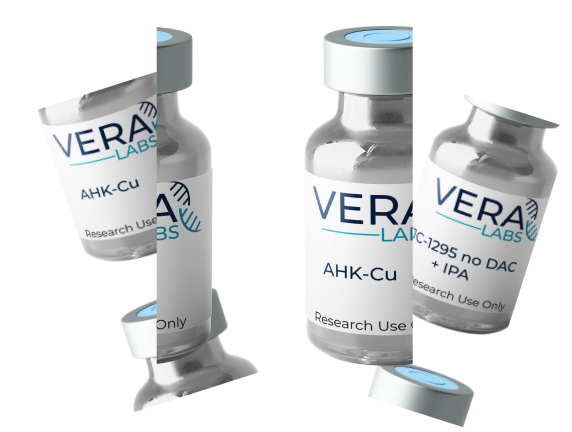
Products listed on VeraLabs are intended only for in vitro laboratory research. The term in vitro refers to experiments conducted outside a living organism, typically in controlled environments like lab equipment, test tubes, or cell cultures.
These compounds are:
- Not approved by the FDA
- Not classified as pharmaceutical drugs
- Not intended for human or animal consumption
Any form of use for treatment, diagnosis, or medical application is strictly prohibited.
What Are Research Peptides?
Research peptides are lab-created molecular compounds designed to assist scientists in studying biological systems. These molecules are synthesized under controlled laboratory conditions and are widely used in scientific research.
Their primary applications include:
- Studying cellular behavior
- Analyzing molecular interactions
- Supporting biochemical experiments
Instead of being used directly in living organisms, research peptides act as tools for discovery, helping researchers better understand how biological processes work.
Why In Vitro Research Matters
In vitro research plays a critical role in modern science. It allows researchers to conduct experiments in a controlled environment without involving human or animal subjects.
Common in vitro applications:
- Cell culture testing
- Protein interaction analysis
- Drug discovery experiments
This method ensures precision, safety, and repeatability, making it essential for early-stage scientific exploration.
From Research Peptides to Approved Drugs
Although research peptides themselves are not used as treatments, they often serve as the foundation for developing peptide-based medications.
Globally, dozens of peptide drugs have been approved after passing strict regulatory processes. These include:
- Laboratory research
- Preclinical evaluation
- Clinical trials (Phase I–III)
Only after proving safety and effectiveness can a compound become a medically approved drug.
Research Peptides vs. Pharmaceutical Drugs
Understanding the difference is important for compliance and safety.
Regulatory Status
- Approved drugs meet strict FDA regulations and manufacturing standards
- Research peptides are not regulated as medicines and are used only for lab research
Usage Purpose
- Pharmaceutical drugs are used for treating diseases
- Research peptides are used for studying biological mechanisms and developing new compounds
Research peptides must remain within laboratory environments only.
Scientific Importance of Research Peptides
Research peptides are considered essential building blocks in drug discovery. Scientists use them to explore new possibilities in medicine and biology.
Advanced techniques include:
- Modifying natural peptide structures
- Adding synthetic amino acids
- Creating targeted molecular designs
These innovations help researchers:
- Discover new therapeutic targets
- Study disease mechanisms
- Develop next-generation treatments
The Drug Development Journey
Transforming a research peptide into a real-world treatment is a long and complex process.
Typical Development Path:
Basic Research → Preclinical Testing → Clinical Trials → Regulatory Approval
This process can take:
- 10–15 years
- Millions to billions in investment
Strict global standards (such as ICH guidelines) ensure that only safe and effective compounds reach clinical use.
Conclusion
Research peptides are not medicines, but they play a vital role in advancing science. By enabling controlled experimentation and deeper biological understanding, they help pave the way for future medical breakthroughs.
Browse the full Vera Labs catalog of research peptides and compounds, carefully packaged and shipped within the US.