Educational Disclaimer
All content and product-related information on this website are provided strictly for educational and research purposes only.
Products available at VeraLabs are intended exclusively for in vitro laboratory research. The term in vitro refers to experiments conducted outside living organisms, such as in controlled lab environments.
These compounds:
- Are not approved by the FDA
- Are not pharmaceutical products
- Must not be used for human or animal consumption
Any use for medical or therapeutic purposes is strictly prohibited.
What Is Peptide Synthesis?
Peptide synthesis is the process of building peptide chains by linking amino acids together through peptide (amide) bonds.
This process allows scientists to create:
- Short peptide sequences (oligopeptides)
- Longer chains (polypeptides)
Peptide synthesis is a key area in bioorganic chemistry, enabling the production of research peptides and the development of peptide-based technologies.
Types of Peptide Synthesis Methods
Peptides can be produced using two main approaches:
1. Chemical Synthesis
This method uses controlled chemical reactions to assemble amino acids step by step.
Solid-Phase Peptide Synthesis (SPPS)
- The most widely used technique
- Peptide chain is built on a solid resin
- Allows automation and high efficiency
👉 Ideal for research peptides and pharmaceutical development.
2. Biological (Biosynthesis) Methods
Peptides are produced inside living systems or engineered cells.
- Uses ribosomes or enzyme systems
- Follows genetic instructions (mRNA templates)
- Suitable for longer or naturally occurring peptides
How Peptide Synthesis Works (Step-by-Step)
In chemical synthesis—especially SPPS—the process follows a structured sequence:
- Attachment to Resin
- The first amino acid is anchored to a solid support
- Protection of Functional Groups
- Prevents unwanted reactions during synthesis
- Deprotection Step
- Removes protective groups to allow bonding
- Coupling Reaction
- Adds the next amino acid to the chain
- Repetition Cycle
- Steps are repeated until the full sequence is built
- Cleavage & Final Processing
- Peptide is released from the resin
- Protecting groups are removed
Molecular Mechanism Behind Peptide Formation
Peptide chains are assembled in a controlled directional manner, typically from the C-terminal to the N-terminal.
Key considerations include:
- Preventing unwanted side reactions
- Maintaining sequence accuracy
- Ensuring proper bond formation
In biosynthesis, peptide formation occurs naturally through:
- Ribosomal translation (mRNA-guided)
- Enzyme-driven assembly systems
Key Technologies in Peptide Synthesis
To achieve high-quality results, several technologies are involved:
1. Coupling Reagents & Reaction Control
- Improve bonding efficiency
- Reduce errors like incomplete reactions
2. Solvent Optimization
- Ensures proper reaction environment
- Helps prevent aggregation in longer peptides
3. Advanced Purification
After synthesis, peptides are purified using:
- RP-HPLC (Reverse-Phase Chromatography)
- Gel filtration techniques
4. Analytical Verification
To confirm structure and quality:
- Mass Spectrometry (MS)
- Nuclear Magnetic Resonance (NMR)
Challenges in Peptide Synthesis
Some common issues include:
- Aggregation in long peptide chains
- Side reactions affecting purity
- Sequence errors (mismatches)
To overcome these:
- Specialized solvents may be used
- Segment-based synthesis strategies are applied
Quality Control in Peptide Production
High-quality peptide synthesis requires strict control measures:
- Verification of amino acid purity
- Monitoring reaction efficiency
- Impurity profiling
- Consistent batch production
In advanced systems, optimized production methods ensure peptides meet research-grade or pharmaceutical-level standards.
Final Thoughts
Peptide synthesis is a fundamental technology that enables scientists to design and produce custom peptide sequences with precision. From laboratory research to large-scale production, modern synthesis techniques continue to improve efficiency, accuracy, and scalability.
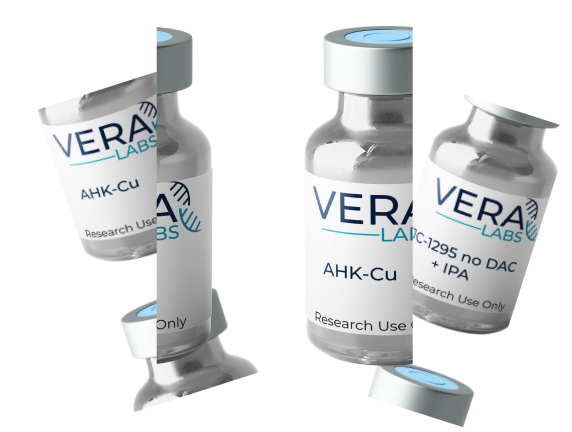
Browse the full Vera Labs catalog of research peptides and compounds, carefully packaged and shipped within the US.