Educational Disclaimer
All information shared on this website is intended strictly for educational and research purposes.
Products available on VeraLabs are designed exclusively for in vitro laboratory research. The term in vitro refers to experiments performed outside living organisms, such as in controlled lab environments.
These compounds:
- Are not approved by the FDA
- Are not pharmaceutical drugs
- Must not be used for human or animal consumption
Any use for medical or therapeutic purposes is strictly prohibited.
What Is Peptide Solubility?
Peptide solubility describes how much of a peptide can dissolve in a specific solvent under defined conditions such as temperature and pH.
It is usually measured as:
- Mass concentration (g/L)
- Molar concentration (mol/L)
Solubility is a key property because it affects:
- Preparation and formulation
- Storage stability
- Experimental performance in lab settings
Why Solubility Matters in Peptide Research
In research environments, poor solubility can lead to:
- Incomplete dissolution
- Aggregation of peptide molecules
- Inconsistent experimental results
On the other hand, well-dissolved peptides ensure:
- Accurate dosing in experiments
- Better reproducibility
- Improved handling and storage
Main Factors Affecting Peptide Solubility
Peptide solubility depends on both internal molecular structure and external conditions.
1. Amino Acid Composition
- Peptides rich in polar amino acids dissolve more easily
- Nonpolar (hydrophobic) amino acids reduce solubility and may cause aggregation
2. Peptide Length
- Short peptides are generally more soluble
- Longer chains tend to interact more and form aggregates
3. Charge & pH Conditions
- Solubility improves when peptides carry a net charge
- At certain pH levels, electrostatic repulsion helps prevent clumping
4. Solvent Type
- Water is commonly used, but some peptides require:
- Organic solvents (e.g., methanol, DMSO)
- Mixed solvent systems
5. Ionic Strength
- Salt concentration can influence solubility
- High salt levels may cause “salting out” (precipitation)
Methods to Measure Peptide Solubility
Equilibrium Solubility Method
- Peptide is mixed with solvent until saturation
- Concentration is measured after equilibrium
👉 Reliable but time-consuming
Spectroscopic Analysis
- Uses absorbance to estimate concentration
- Fast and efficient
👉 Requires careful control to avoid interference
HPLC (High-Performance Liquid Chromatography)
- Highly accurate and sensitive
- Works well with complex or impure samples
Dynamic Light Scattering (DLS)
- Measures aggregation behavior
- Helps assess dissolution quality indirectly
How to Improve Peptide Solubility
1. Chemical Modification
- Add polar groups
- Replace hydrophobic amino acids
👉 Improves interaction with solvents
2. Solvent Optimization
- Use co-solvents like DMSO or methanol
- Add surfactants to improve dispersion
3. pH Adjustment
- Adjust solution pH away from the isoelectric point
- Helps maintain charge and prevent aggregation
4. Formulation Techniques
- Use lyophilized (freeze-dried) forms
- Develop nanoparticles or specialized delivery systems
5. Control Ionic Conditions
- Avoid excessive salt concentrations
- Maintain balanced ionic strength
Best Practices for Handling Peptides
- Always choose solvent based on peptide properties
- Avoid sudden temperature or pH changes
- Prepare fresh solutions when possible
- Store under recommended conditions
Final Thoughts
Peptide solubility is a critical factor in ensuring successful research outcomes. By understanding how molecular structure and environmental conditions affect solubility, researchers can optimize preparation methods and achieve consistent results.
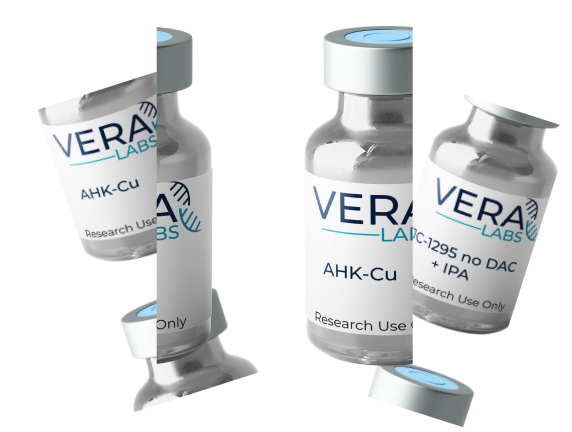
Browse our solubilization medium and research compounds, packaged with care and shipped within the US.