Educational Disclaimer
All information and product-related content on this website is provided strictly for educational and research purposes only.
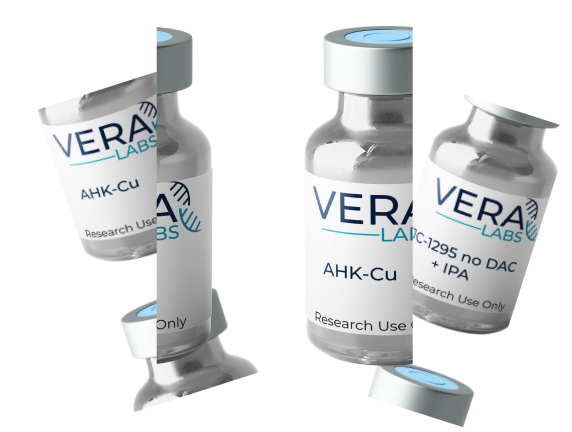
Products available at VeraLabs are intended exclusively for in vitro laboratory research. The term in vitro refers to experiments conducted outside living organisms in controlled environments such as laboratory glassware or cell cultures.
These compounds:
- Are not approved by the FDA
- Are not pharmaceutical drugs
- Must not be used for human or animal consumption
Any use for medical, diagnostic, or therapeutic purposes is strictly prohibited.
What Is Peptide Purification?
Peptide purification is the process of isolating a target peptide from a crude mixture obtained after synthesis or biological expression.
During peptide production, unwanted substances are always present, including:
- Incomplete or truncated peptide chains
- Synthesis by-products
- Mis-sequenced peptides
- Host cell proteins (in recombinant methods)
- Chemical impurities and endotoxins
The goal of purification is to remove these impurities and achieve high-purity peptides suitable for research or further development.
Why Peptide Purification Is Important
Purification is a critical step because impurities can:
- Affect biological activity
- Reduce stability
- Interfere with experimental results
- Introduce safety risks in advanced applications
High-purity peptides ensure:
- Reliable research outcomes
- Consistent performance
- Better reproducibility in experiments
How Peptide Purity Is Measured
To confirm purity and quality, several analytical techniques are used:
- HPLC (High-Performance Liquid Chromatography) – measures purity level
- Mass Spectrometry (MS) – confirms molecular weight and identity
- SDS-PAGE – evaluates protein/peptide separation
These methods help ensure that peptides meet required research standards.
Stages of Peptide Purification
Peptide purification is typically performed in multiple steps:
1. Initial (Primary) Purification
Removes bulk impurities using methods like:
- Centrifugation
- Ultrafiltration (UF)
- Solid-phase extraction (SPE)
2. Intermediate (Fine) Purification
This stage focuses on separating peptides based on specific properties such as:
- Hydrophobicity
- Charge
- Molecular size
3. Final (Polishing) Purification
Used to achieve high-purity levels, often above 95–99%.
Techniques include:
- Secondary chromatography
- Membrane filtration
- Advanced refinement processes
Key Peptide Purification Techniques
Reversed-Phase HPLC (RP-HPLC)
This is one of the most widely used purification methods.
- Separates peptides based on hydrophobic properties
- Uses C18 or C8 columns
- Offers very high resolution
👉 Ideal for distinguishing even small differences in peptide structure.
Ion-Exchange Chromatography (IEX)
Separates peptides based on charge differences.
- Uses anion or cation exchange resins
- Controlled by pH and salt gradients
👉 Effective for removing charge-related impurities.
Size-Exclusion Chromatography (SEC)
Separates molecules based on size (molecular weight).
- Larger molecules elute faster
- Smaller molecules take longer
👉 Useful for removing aggregates or large impurities.
Affinity Chromatography
A highly selective method based on specific binding interactions.
- Uses ligands like antibodies or metal ions
- Common in recombinant peptide purification
👉 Ideal for isolating tagged peptides (e.g., His-tag).
Hydrophobic Interaction Chromatography (HIC)
Separates peptides using hydrophobic interactions in high-salt conditions.
- Binding occurs in high salt
- Elution happens as salt concentration decreases
👉 Often used alongside other purification methods.
Peptide Purification Process & System
A complete purification setup includes:
- Solvent and buffer systems
- Chromatography columns
- Detectors and monitoring tools
- Fraction collection systems
Each component plays a role in ensuring efficient separation and accurate analysis.
Quality Control & cGMP Standards
In advanced peptide production, strict quality control systems are followed to ensure consistency and safety.
Key Quality Principles:
- Standardized procedures for every step
- Full documentation and traceability
- Validated analytical methods
- Controlled process parameters
The concept of Quality by Design (QbD) is often applied, meaning:
- Processes are carefully planned and optimized
- Critical parameters are defined and controlled
- Results are reproducible and reliable
Final Thoughts
Peptide purification is essential for transforming raw peptide mixtures into high-quality research-grade compounds. By combining advanced techniques and strict quality standards, scientists can ensure purity, stability, and performance in laboratory applications.
Browse the full Vera Labs catalog of research peptides and compounds, carefully packaged and shipped within the US.