Educational Disclaimer
All information shared on this website is provided strictly for educational and research purposes only.
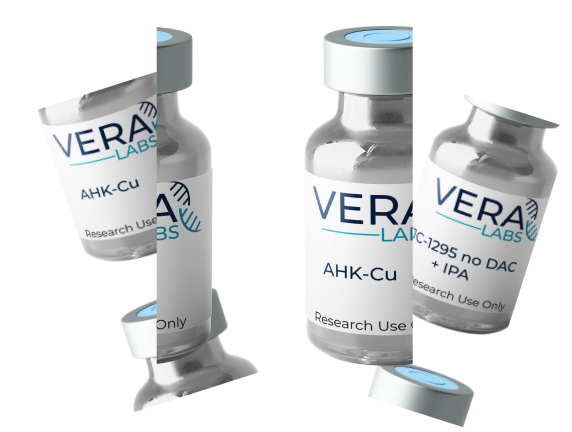
Products available on VeraLabs are intended exclusively for in vitro laboratory research. The term in vitro refers to experiments conducted outside living organisms in controlled environments.
These compounds:
- Are not approved by the FDA
- Are not pharmaceutical products
- Must not be used for human or animal consumption
Any use for medical or therapeutic purposes is strictly prohibited.
What Is a Peptide Bond?
A peptide bond is a covalent chemical bond that links amino acids together to form peptides and proteins.
It is created when:
- The carboxyl group (–COOH) of one amino acid
- Reacts with the amino group (–NH₂) of another
This reaction releases a molecule of water, making it a condensation (dehydration) reaction.
👉 The resulting bond is known as an amide linkage (–CO–NH–).
Role of Peptide Bonds in Peptide Structure
Peptide bonds form the backbone of peptide chains, connecting amino acids in a linear sequence.
Each chain has:
- An N-terminal (amino end)
- A C-terminal (carboxyl end)
These bonds repeat to build the entire structure of peptides and proteins.
How Peptide Bonds Are Formed in Biological Systems
Inside living systems, peptide bonds are formed during protein synthesis in ribosomes.
Basic Process:
- tRNA molecules carry amino acids
- mRNA provides the sequence template
- Amino acids are aligned in the ribosome
- A peptide bond forms between adjacent amino acids
- The chain grows step by step
This process:
- Requires energy (GTP)
- Follows a precise genetic sequence
- Builds peptides from N-terminal to C-terminal direction
Structural Features of Peptide Bonds
Peptide bonds have unique structural properties that influence protein shape:
1. Partial Double-Bond Character
- The bond has limited rotation
- Creates rigidity in the peptide backbone
2. Planar Structure
- Atoms involved in the bond lie in the same plane
- Stabilizes the overall structure
3. Trans Configuration
- Most peptide bonds exist in a trans form
- Reduces steric hindrance between atoms
Physicochemical Properties
Peptide bonds contribute to several important molecular behaviors:
Hydrogen Bonding
- Can act as both hydrogen bond donors and acceptors
- Essential for forming structures like:
- Alpha-helices
- Beta-sheets
UV Absorption
- Peptide bonds absorb UV light (around 210–230 nm)
- Useful for measuring protein concentration
Chemical Stability
- Generally stable under normal conditions
- Can be broken down by enzymes (proteases)
Biological Importance of Peptide Bonds
Peptide bonds are essential for maintaining the structure and function of proteins.
They help:
- Preserve enzyme activity
- Maintain structural proteins
- Support biological signaling processes
At the same time, controlled breakdown of peptide bonds allows:
- Protein recycling
- Regulation of cellular functions
Applications in Science & Biotechnology
Peptide bonds play a major role in modern research and technology:
Peptide Synthesis
- Used to build custom peptide sequences
- Controlled through chemical methods
Protein Analysis
- Techniques use peptide bond cleavage for sequencing
- Helps identify amino acid order
Drug Development
- Peptide bond analogs are used in designing inhibitors
- Important in targeting enzyme activity
Final Thoughts
The peptide bond is a fundamental element in biochemistry, connecting amino acids into functional chains. Its unique structural and chemical properties make it essential for protein formation, stability, and biological activity.
Understanding peptide bonds is key for anyone involved in peptide research, biotechnology, or molecular science.
Browse the full Vera Labs catalog of research peptides and compounds, carefully packaged and shipped within the US.